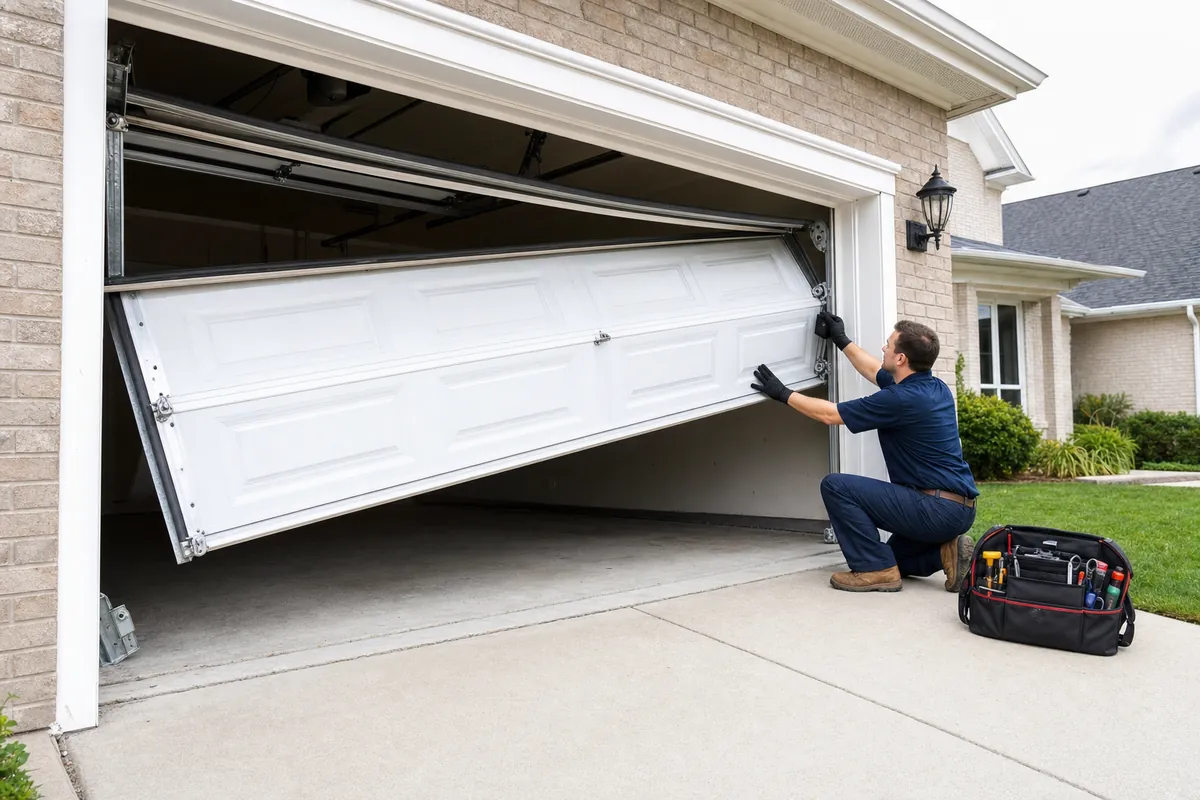

Emergency Garage Door Repair
Fast attention for doors stuck open, jammed part-way, or hanging out of square.
View serviceA door frozen to the slab is a bond, not a fault. Forcing it with the operator is what turns a five-minute job into a repair.
Do not run the operator repeatedly. Disconnect it, break the ice bond along the bottom seal with warm, not boiling, water and a plastic scraper, and clear ice from the lower tracks and from in front of the door. Then lift by hand. Once it is open, clear and dry the threshold before closing it again, and check the seal for splits and the slab for a low spot holding water.
Whitby's winters produce a specific failure that has nothing to do with the door's mechanics. Snow gets tracked in, meltwater runs to the lowest point at the threshold, temperatures drop overnight, and the bottom weatherseal freezes to the concrete. In the morning the operator pulls against a door that is glued down, the force monitor either gives up or the seal tears, and in the worst case a bottom bracket or a cable takes the load. Freeing the door is mostly patience and warm water. Keeping it free is drainage and seal condition.
Start at the top. The early checks are the most common causes and need no tools.
Unplug the operator or disconnect it with the manual release, with the door closed. Repeated attempts do not break an ice bond; they load the seal, the bottom brackets and the cables against a door that is not going to move, and that is where the damage happens.
What it means: Stopping the operator is the single most useful step and prevents most of the resulting damage.
Look along the whole bottom edge for ice between the seal and the slab, then check the lower few inches of both vertical tracks and the area immediately in front of the door. Ice in a track or a frozen drift against the outside face is a different problem from a seal bonded to concrete.
What it means: Knowing whether it is the seal, the tracks or a drift determines what you clear first.
Use warm, not boiling, water along the bond line, and work a plastic scraper or a stiff plastic tool between the seal and the slab. Avoid metal scrapers, chisels and heat guns, all of which damage the seal or the panel finish. Give it a few minutes rather than expecting an instant release.
What it means: A clean release with the seal intact means the bond broke rather than the rubber tearing.
Once the bond is broken, lift the door by hand with the operator still disconnected. Check the bottom seal along its length for splits and sections pulled out of their retainer, since a torn seal will let water in and refreeze the door the following night.
What it means: A split or displaced seal needs replacing before the next freeze rather than in spring.
Shovel and sweep the threshold, chip out any remaining ice ridge, and let the concrete dry as much as the weather allows before closing the door. Where a low spot in the slab holds meltwater, that spot is where the door will bond again, so it is worth noting for a proper fix.
What it means: A dry, clear threshold is what stops the same problem repeating tomorrow morning.
Do not use boiling water, a heat gun, a propane torch or a metal chisel on a frozen door: the first two damage the seal and the panel finish, the last two cut the rubber and the paint. Do not increase the operator's force setting to break the ice, since that removes its ability to detect a real obstruction. If the door has already been forced and a cable is now slack, a bottom bracket has moved or the door sits crooked, stop and report it rather than cycling the door again.
This is the most Whitby-specific problem on the site. Durham Region's climate analysis gives a baseline of about 80 days a year when temperatures cross the freezing point, using Whitby as the regional proxy location, and the nearest official station records a January mean of -4.8 C, a daily minimum near -8.5 C, about 105.8 cm of snow and 871.9 mm of precipitation a year. Roughly eighty crossings of the freezing point is a lot of melt-and-freeze cycles at a threshold, which is why seal condition and drainage matter more here than in milder parts of the province.
Fast attention for doors stuck open, jammed part-way, or hanging out of square.
View service
Balance test, hardware torque, lubrication and a full safety-system check.
View service
Slack, frayed or unwound lift cables replaced and rewound evenly on the drums.
View serviceFill out the form and we'll confirm your appointment by email.
These guides are written for Whitby homes. If the fix is beyond a homeowner check, we work everywhere inside this area.
Map data © Google. Pin shows the service area, not a walk-in location — all work is done at your home.
A real callout, not stock imagery.
A sectional door pulled off its tracks, taken down and supported on site so it could be checked and re-hung safely — photographed on the job.