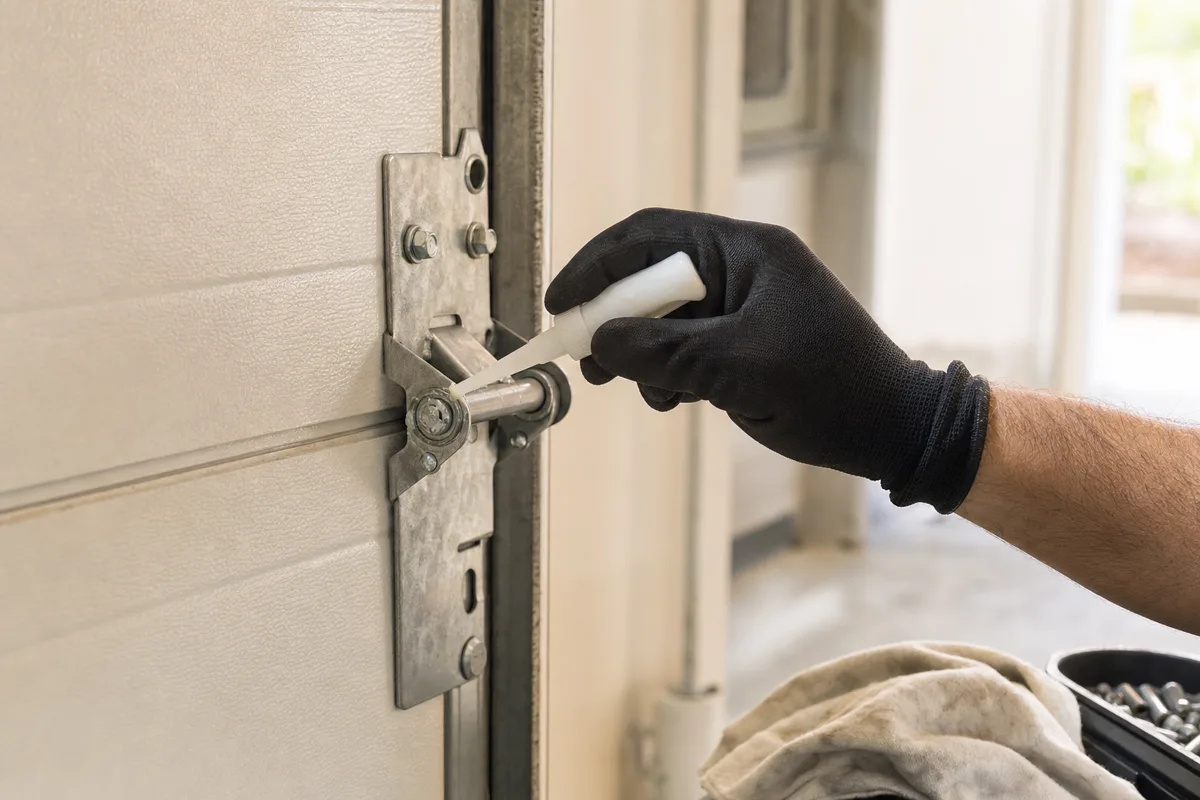

Garage Door Roller & Track Repair
Seized rollers renewed, bent rails straightened, derailed doors re-railed and squared.
View serviceGarage door noises are surprisingly diagnostic. Where the sound comes from, and when in the cycle it happens, narrows the cause down quickly.
Grinding or scraping that moves with the door means seized rollers or misaligned track. A rhythmic squeak or knock above the opening means the shaft bearings or the cable drums. A rattle that changes with speed means loose hinges, brackets or lag bolts. A single sharp bang followed by a door that will not lift means a broken spring: stop using the door. Lubricating bearings and hinge pins helps genuine dryness; it will not fix alignment or wear.
A door that has grown noisier over a year or two is telling you that friction has increased somewhere, and friction is what wears out the expensive parts. Grinding and scraping that follows the door along its travel is almost always the guide system: rollers, hinges or track. A rhythmic squeak or knock from above the opening is the shaft assembly, its bearings and drums. Rattling that rises and falls with speed is loose hardware. And a single loud bang, after which the door will not lift, is a different category of problem entirely and should be treated as one.
Start at the top. The early checks are the most common causes and need no tools.
Have someone cycle the door while you stand back and listen. Does the noise travel up and down with the door, stay fixed above the opening, or come from the operator and its rail? That single observation separates guide-system faults from shaft faults from drive faults.
What it means: Noise that follows the door means rollers, hinges or track; noise fixed above it means the shaft.
With the door closed and the operator disconnected, try turning each roller wheel by hand. A healthy roller turns freely. One that will not turn, or grates as it does, has a failed bearing and has been sliding along the track rather than rolling.
What it means: Any roller that will not spin freely is the likely source of grinding and needs replacing.
Sight down the vertical track for kinks, flat spots and dents, and check that the jamb brackets are tight and the track is plumb. Then look at the curve where vertical becomes horizontal, since binding and shuddering usually show up first at that transition.
What it means: A kink or a loose bracket puts a sideways load on every roller and needs correcting first.
Look at hinges, roller brackets, lag bolts and the ceiling hangers holding the operator rail. Elongated holes, shiny witness marks around a fastener and any visible movement during a cycle all indicate fixings that have worked loose over years of small shocks.
What it means: Loose fasteners explain rattling and, left alone, let the door run out of square.
A single loud report, often described as sounding like a firework inside the house, is usually a torsion spring fracturing. Check the springs above the opening for a visible gap in the coils, from a safe distance, and check whether the door has become heavy by hand.
What it means: A gap in a spring coil means the door should not be operated until it is repaired.
Do not attempt to adjust, lubricate under tension or reposition a torsion spring, and do not handle a cable that is slack or frayed. Do not lubricate the track running surface: rollers are meant to roll, and a slick track makes sliding worse. Keep out from under a door that shudders badly or runs visibly out of square, and stop using a door that banged and then became heavy. Note where the noise comes from and when it happens, and send that with your request.
Noise complaints in Whitby cluster in the Town's middle-aged housing. Blue Grass Meadows has 49 per cent of its dwellings from the 1980s and Rolling Acres 43 per cent from the 1990s, which puts thousands of doors at the age where original rollers have seized and hinge fixings have worked loose. Whitby's winters add to it: with roughly 80 freeze-thaw days a year in Durham, moisture works into roller bearings and then freezes, which is why a door that was merely noisy in November often starts grinding in January.
Seized rollers renewed, bent rails straightened, derailed doors re-railed and squared.
View service
Balance test, hardware torque, lubrication and a full safety-system check.
View service
Counterbalance tension, bearings and shaft hardware corrected on intact springs.
View serviceFill out the form and we'll confirm your appointment by email.
These guides are written for Whitby homes. If the fix is beyond a homeowner check, we work everywhere inside this area.
Map data © Google. Pin shows the service area, not a walk-in location — all work is done at your home.

A real callout, not stock imagery.
A sectional door pulled off its tracks, taken down and supported on site so it could be checked and re-hung safely — photographed on the job.