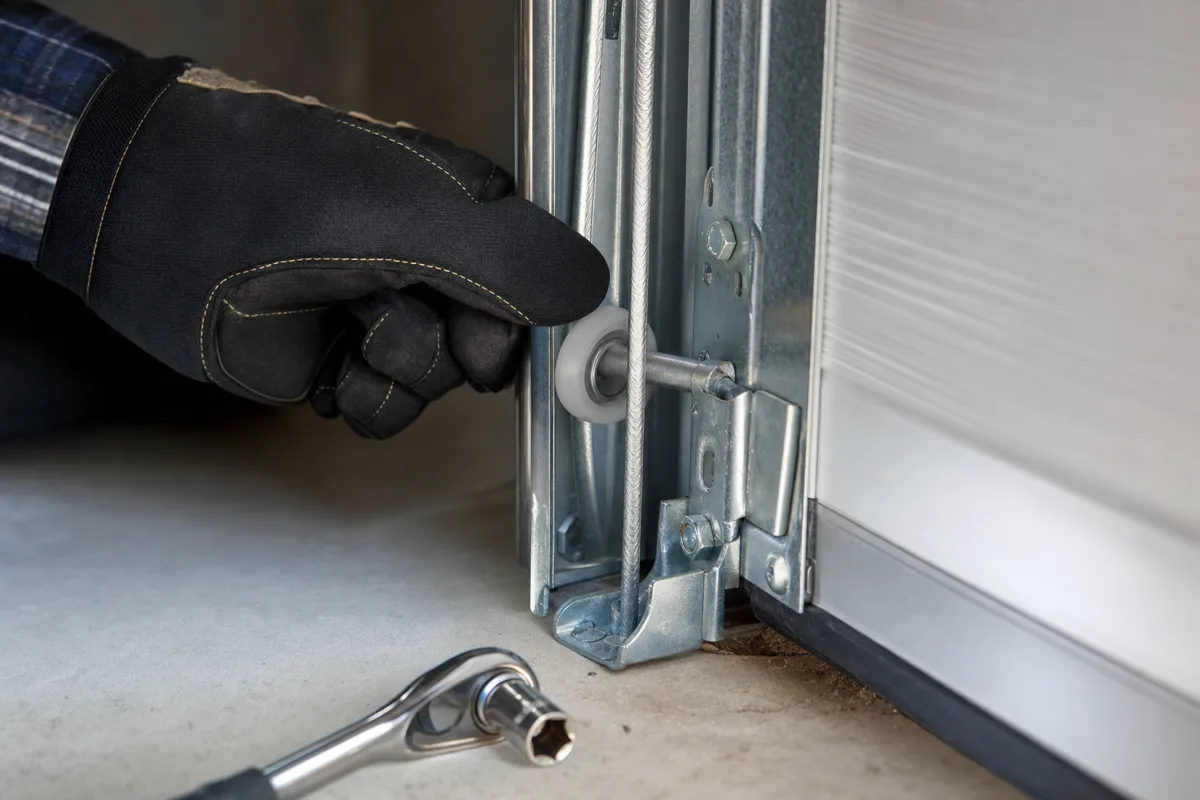

Emergency Garage Door Repair
Fast attention for doors stuck open, jammed part-way, or hanging out of square.
View serviceA door off its track is holding several hundred pounds in a position it was never designed to rest in. This is the one fault where the correct first action is to do nothing.
Do not run the operator and do not try to lever the door back in. Keep people and vehicles clear, and if the door is part-way open leave it where it is rather than pulling the manual release. Note which corner came out, whether a cable is slack, and what happened immediately beforehand, then send that with your request. A derailed door is re-seated with the assembly supported and the cause corrected at the same time.
When a roller leaves its track, the door stops being a controlled assembly. Its weight is now carried unevenly across hinges, cables and the sections themselves, and any attempt to run it or lever it back in can release that load suddenly. There is usually a cause behind it: a seized roller, a broken cable, an impact, a loose bracket or an opening that has moved out of square. Identifying that cause matters, because a door put back in its track without addressing it will come out again.
Start at the top. The early checks are the most common causes and need no tools.
Move vehicles, bikes and people out from under and around the door. A derailed door can shift without warning as the load redistributes, and the section edges and cable ends are both hazards. This is a stand-back situation rather than a look-closer one.
What it means: An area kept clear is the difference between a repair and an injury.
Unplug the operator or switch off its breaker so nobody in the household can send a command by remote or keypad. Running a derailed door bends track, buckles sections and can pull a cable off a drum, which turns a two-roller problem into a much larger repair.
What it means: Isolating power prevents the most common escalation of an off-track door.
From a safe distance, identify which side has come out, how many rollers are out of the track, and whether the door is jammed, leaning outward or resting against the opening. Photographs from a few feet back are more useful than a written description.
What it means: Knowing the extent lets the right parts and support equipment be brought on the first visit.
Check both sides, still from a distance, for a cable that has gone slack, unwound from its drum or frayed. A cable failure is one of the common reasons a door derails, and it changes the repair from a re-seating job to a counterbalance job. Do not touch the cable or a bottom bracket.
What it means: A slack cable means the counterbalance system is involved, not just the guide system.
Think back over the last few cycles. Was there a grinding noise for weeks? Did a vehicle or a ladder contact the door? Did it stick at the threshold in a freeze and get forced? Did it start closing on something? Each of those points to a different underlying cause and a different fix.
What it means: The history usually identifies the cause, which is what stops the derailment repeating.
Do not lever, pry, hammer or lift a derailed door back into its track. It is supporting itself unevenly and can drop. Stay away from the cables and the bottom brackets, which are connected directly to the lift load and may have unequal tension. Do not pull the manual release on a door that is part-way open, and do not run the operator to see whether the door will re-seat itself. Keep children and pets out of the garage entirely until the door has been made safe.
Two Whitby patterns produce most derailments. The first is age: in Lynde Creek and West Lynde, 55 per cent of dwellings date from 1961 to 1980, and long-serving rollers and cables are the usual starting point. The second is winter. With about 80 freeze-thaw days a year in Durham on the regional baseline, doors bond to slabs overnight, get forced in the morning, and lose a roller or a cable in the process. Frost movement over many winters also leaves openings slightly out of square, which is why one roller ends up riding high.
Fast attention for doors stuck open, jammed part-way, or hanging out of square.
View service
Seized rollers renewed, bent rails straightened, derailed doors re-railed and squared.
View service
Slack, frayed or unwound lift cables replaced and rewound evenly on the drums.
View serviceFill out the form and we'll confirm your appointment by email.
These guides are written for Whitby homes. If the fix is beyond a homeowner check, we work everywhere inside this area.
Map data © Google. Pin shows the service area, not a walk-in location — all work is done at your home.
A real callout, not stock imagery.
A sectional door pulled off its tracks, taken down and supported on site so it could be checked and re-hung safely — photographed on the job.