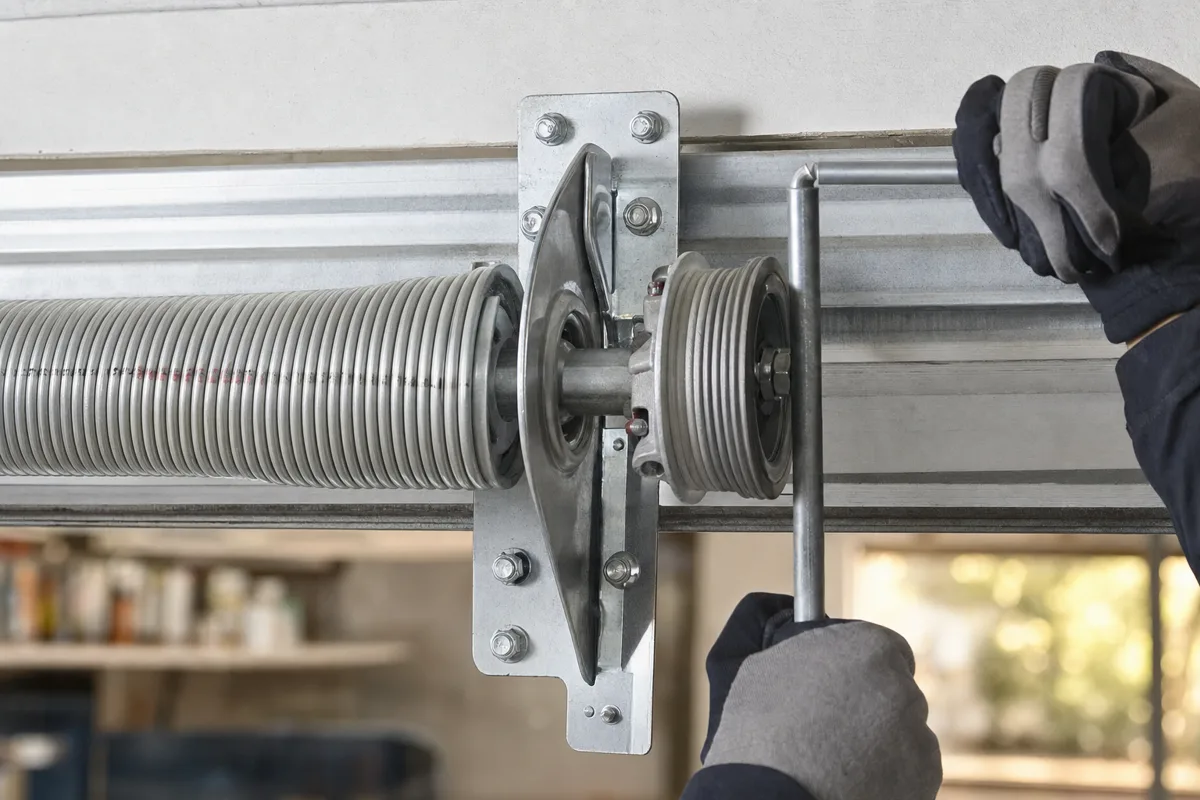

Garage Door Spring Replacement
Snapped torsion and extension springs renewed as correctly matched sets.
View serviceA broken counterbalance spring is the most common serious garage door failure, and the signs are unambiguous once you know what to look for.
Look for a visible gap of an inch or two in the coils of a torsion spring above the door, or an extension spring hanging loose beside the track. Other signs: a bang followed by a door that will not lift, a door that feels dramatically heavier by hand, an operator that hums and strains without moving it, or a door that lifts a few inches and stalls. Stop using the door and do not pull the manual release if it is part-way open.
The springs carry the door's weight. When one breaks, the weight transfers instantly to the cables, the drums and whatever else is holding the door, which is why a broken spring turns a hundred-and-fifty-pound door that lifted with two fingers into something that will not move. Most people hear it happen: a bang loud enough to carry through the house, often overnight or on the first cold morning cycle. The visual confirmation is a gap in the coils of a torsion spring above the opening, or a slack extension spring hanging beside the horizontal track.
Start at the top. The early checks are the most common causes and need no tools.
Stand back and look above the closed door. A torsion spring runs along a shaft above the opening. A break shows as a clean gap between coils, usually one to two inches wide, that was not there before. Extension springs run parallel to the horizontal tracks and hang slack when broken.
What it means: A visible gap in the coils is a confirmed break and means the door is unsafe to operate.
A single sharp report, often mistaken for something falling or a firework, is the classic sound of a torsion spring fracturing under load. Cold nights and the first cycle of a winter morning are when it most often happens, because spring steel is least forgiving at low temperatures.
What it means: A bang followed by a door that will not lift is a broken spring until proven otherwise.
With the door fully closed and the operator disconnected, try lifting the door a few inches. A balanced door with intact springs is manageable and holds roughly where you leave it. A door with a broken spring feels like the dead weight it actually is. Stop immediately if it feels heavy.
What it means: A sudden change in weight by hand is a reliable indicator that counterbalance has been lost.
An operator faced with a broken spring typically hums or strains, lifts the door a few inches, then stops or reverses on its force monitor. Some units simply do nothing while the motor runs. That behaviour is the operator refusing an impossible load, not a fault in the operator itself.
What it means: Straining without movement points at the springs rather than at the motor.
When a spring lets go, cables often unwind from their drums or come off entirely, and the door may sit unevenly with one bottom corner lower than the other. Look from a distance; do not touch a slack cable or a bottom bracket, since those points connect directly to the lift load.
What it means: Slack cables or an uneven door mean the failure has spread beyond the spring itself.
Never attempt to replace, wind, unwind or adjust a torsion spring. The stored energy is enough to cause serious injury and it releases instantly. Do not loosen a cone set screw, remove a centre bracket or handle a cable under tension. Do not pull the manual release on a door that is part-way open with a broken spring, because that hands the whole weight to your arms. Keep the door closed, keep everyone out from underneath, and send photographs with your request.
Whitby's housing profile explains the volume of these calls. Of 46,460 occupied dwellings in the Town, 3,810 date from 1960 or earlier and 7,700 from 1961 to 1980, with Lynde Creek and West Lynde sitting squarely in that band at 55 per cent of stock from that period. The 1990s wave of 8,910 dwellings, heavily represented in Rolling Acres, is now reaching a second spring replacement rather than a first. Cold clusters the breaks: the nearest official station records a January daily minimum near -8.5 C.
Snapped torsion and extension springs renewed as correctly matched sets.
View service
Counterbalance tension, bearings and shaft hardware corrected on intact springs.
View service
Fast attention for doors stuck open, jammed part-way, or hanging out of square.
View serviceFill out the form and we'll confirm your appointment by email.
These guides are written for Whitby homes. If the fix is beyond a homeowner check, we work everywhere inside this area.
Map data © Google. Pin shows the service area, not a walk-in location — all work is done at your home.
A real callout, not stock imagery.
A sectional door pulled off its tracks, taken down and supported on site so it could be checked and re-hung safely — photographed on the job.