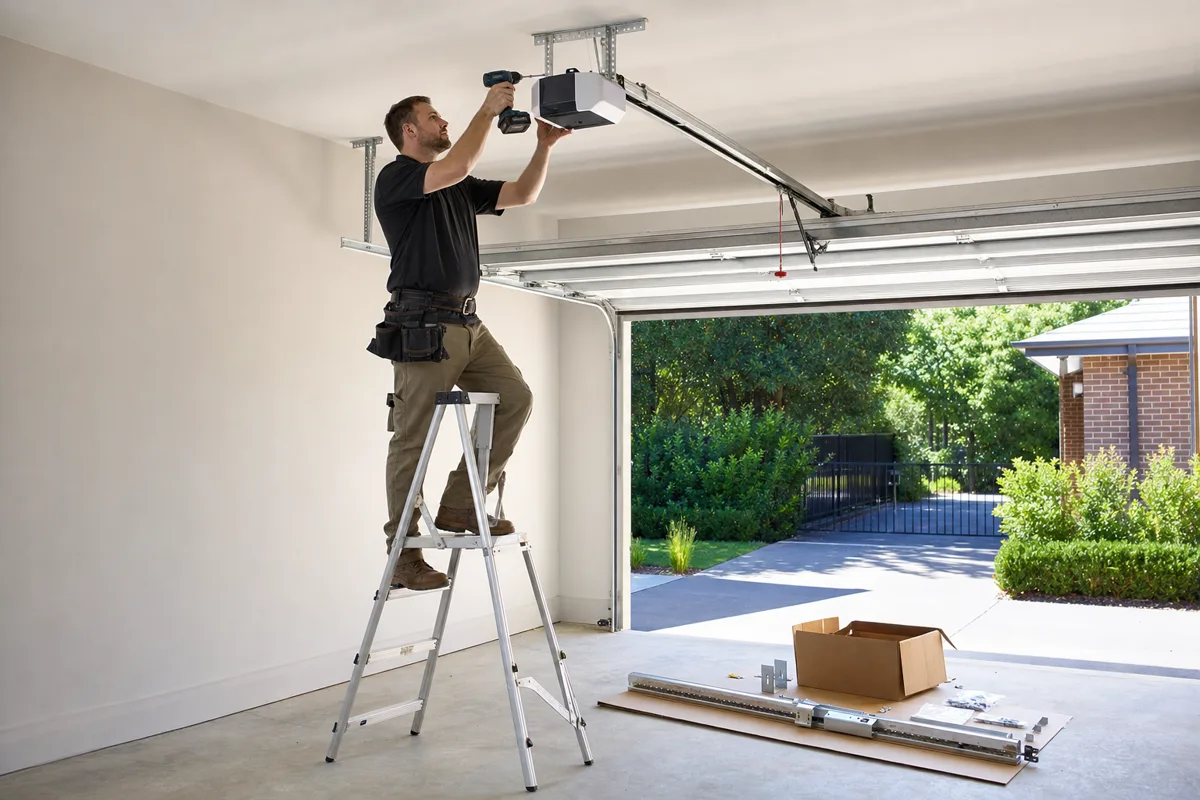

Garage Door Opener Repair
Fault-finding on operators that hum, stall, reverse, or ignore their remotes.
View serviceRemote faults are among the easiest garage door problems to narrow down, because the wall control tells you immediately whether the motor is involved at all.
Test the wall button first. If it works, the fault is in the radio path: try a fresh battery, check whether a second remote or the keypad works, then reprogram the remote to the operator. If no remote and no keypad works but the wall button does, suspect the receiver, the antenna or interference from nearby LED lighting or electronics. If nothing works at all, check power at the outlet and the breaker before anything else.
Start with one question: does the hard-wired wall button still operate the door? If it does, the motor, the drive and the mechanics are fine and the fault is somewhere in the radio path, which is a much smaller and cheaper set of possibilities. If the wall button also does nothing, the problem is power, the logic board or the drive, and the remotes are innocent. Everything after that is a matter of working through batteries, programming, receiver condition and interference in a sensible order rather than replacing parts hopefully.
Start at the top. The early checks are the most common causes and need no tools.
Press the hard-wired button inside the garage. This single test splits the problem in half: a door that responds to the wall button has a working motor, drive and logic board, which means the fault is in the wireless path rather than in the operator's ability to move the door.
What it means: Wall button working plus remotes dead means a radio-side fault, not a motor fault.
Fit a fresh battery of the correct type, check it is the right way round, and clean the contacts if they look dull or corroded. Then test the remote from a few feet away with a clear line of sight. A remote that works close up but not from the street is usually a weak battery or a weak receiver.
What it means: Restored operation after a new battery ends the investigation there.
Test every remote in the household plus the outside keypad if there is one. One dead remote among several working ones is a remote problem. Every remote and the keypad dead, with the wall button working, points at the receiver, the antenna or interference affecting all of them at once.
What it means: One dead device is a device fault; all devices dead is a receiver or interference fault.
Remotes occasionally lose their programming after a power event or a board reset. The learn button on the head unit, usually under the light lens, pairs a remote again in a few seconds. Check the manual for the model rather than guessing, and re-pair the keypad at the same time if it has also stopped.
What it means: If reprogramming restores control, the pairing was lost rather than the hardware failing.
The short antenna wire hanging from the head unit should hang free and undamaged. Then consider recent additions: LED bulbs in the garage, a new router, a smart device or an outdoor light can all put noise onto the operator's frequency. Temporarily removing a suspect item is a quick test.
What it means: Range that returns after removing an LED bulb or device confirms interference.
Isolate power at the outlet or the breaker before opening the head unit cover or touching wiring. Do not remove the light lens or work on the board while the unit is live, and do not stand on something unstable to reach it. Reprogramming from a stepladder is how avoidable injuries happen. If the door has to be operated manually while the fault is investigated, do so only with the door closed and balanced, never with a suspected broken spring.
Cold weather and garage type shape this problem in Whitby. In Taunton North, where 45 per cent of dwellings were built between 2001 and 2005, and in Williamsburg with 34 per cent from the same years, the operators fitted with the house are now at the age where receivers and boards fail rather than remotes. On unheated and detached garages, common in Rural Whitby and the northern hamlets, battery performance drops in the cold: a remote that works indoors and fails at the end of the driveway on a -8 C morning is usually a marginal battery rather than a fault.
Fault-finding on operators that hum, stall, reverse, or ignore their remotes.
View service
Operators sized to the door and commissioned with tested safety reversal.
View service
Balance test, hardware torque, lubrication and a full safety-system check.
View serviceFill out the form and we'll confirm your appointment by email.
These guides are written for Whitby homes. If the fix is beyond a homeowner check, we work everywhere inside this area.
Map data © Google. Pin shows the service area, not a walk-in location — all work is done at your home.

A real callout, not stock imagery.
A sectional door pulled off its tracks, taken down and supported on site so it could be checked and re-hung safely — photographed on the job.